
venpor vs Beeline
Enterprise control.
An AI operating layer
that runs the work.
Beeline is a proven enterprise VMS. venpor takes a different approach: an AI-native operating system that executes contingent workforce workflows across the tools your teams already use.
Both platforms can bring control to the contingent workforce lifecycle. The operating model is different: one gives teams workflows to operate; the other gives them an AI service layer to supervise.
Beeline
Established VMS
A deep system of record
Configured workflows centralise requests, suppliers, workers, time, invoices and reporting.
Log in
→
Find task
→
Take action
→
Follow up
Your team operates the workflow
venpor
AI-native
A governed execution layer
Venny monitors the program, progresses work and brings people the decisions that require judgment.
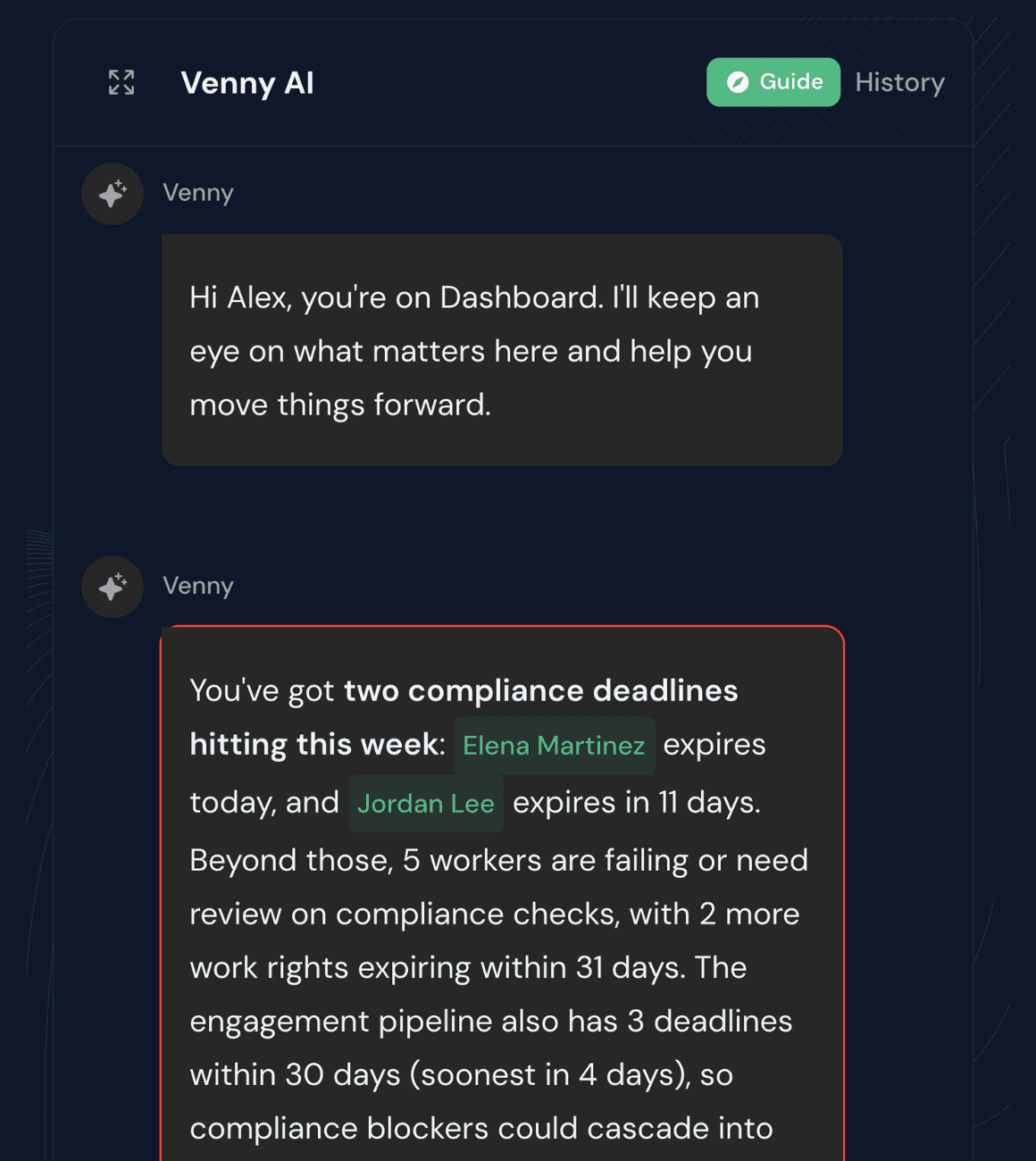
AI executes. Your team supervises.
Beeline
Beeline is consistently rated a top-two VMS. It has deep functionality, strong SOW capabilities, a 125+ country footprint, and post-implementation support that customers genuinely value. For large, complex, MSP-led programs it has earned its reputation.
It is also slowed by its legacy architecture. Implementations are long, often 6 to 8 weeks just to assign a team. The interface is frequently described as clunky. Self-service is limited, so day-to-day reliance on the MSP stays high. The AI story is still largely roadmap.
venpor
venpor covers the same lifecycle across 180 workflows, from workforce planning through offboarding. The difference is the layer on top. Venny monitors your programs, surfaces what needs attention, and executes the work from inside the tools your teams already use.
Your admins run the program in venpor. Everyone else, the hiring managers, approvers, and contingent workers, works from Teams and Slack. There is no new system for them to learn, so adoption is high from day one. venpor is live in 6 weeks, on a flat fee per contingent worker.

If Beeline gives you a deep system of record, venpor gives you the same depth plus an AI that runs it, in a modern interface, live in 6 weeks.
MODEL COMPARISON
Same category. A different operating model.
A concise view of how the two approaches differ.
Exact Beeline capabilities and commercial terms vary
by product and program.
Dimension
Beeline
venpor
Core model
AI-native VMS and orchestration layer
Day-to-day work
Teams operate configured workflows
Venny executes governed workflows
User experience
VMS application with integrations
venpor, Teams, Slack, ATS or ERP
AI role
Insights, assistance and automation
Monitors, surfaces and executes
Deployment
Program-specific implementation
Overlay or replace. Start narrow.
Commercial model
Contract-specific
Flat fee per active worker
Human role
Operate the process
Set the rules. Supervise exceptions.
PRACTICAL PATH FORWARD
Don't rip out Beeline on day one.
Start where the drag is highest. Let venpor orchestrate a real workflow across the tools already in place, prove the value, then decide what moves next.
01
→
Connect the reality
Map Beeline, ATS, HRIS, ERP, collaboration tools and the manual handoffs between them.
Weeks 1–2
02
▶
Run one workflow
Deploy Venny around one high-friction process, category, region or site with agreed guardrails.
Weeks 3–6
03
◆
Prove and expand
Measure time saved, adoption and control. Add workflows or consolidate systems when the case is clear.
Week 6 onward
✓
An AI that runs the work
Venny opens requisitions, chases timesheets, flags expiring documents, and tells you what was handled. Not a portal you have to operate.
✓
Live in 6 weeks
Software, not a multi-month services engagement. Beeline can take 6 to 8 weeks just to assign an implementation team.
✓
Modern by default
Lives in Teams and Slack, where your hiring managers already work. Adoption is built in, not trained in.
✓
Onboarding that runs itself
Venny onboards every user by role and permission and walks each one through their tasks step by step. Self-serve, no services team required.
✓
Independent and open
Connects to your ATS, HRIS, and ERP through an adaptive integration layer. Not a closed stack you have to fit around.
✓
Trustworthy AI
A dedicated quality and safety subsystem evaluates Venny continuously and gates every change before it reaches your program.
✓
The lifecycle starts 18 months earlier
venpor pre-positions demand before a requisition exists. A VMS only starts when the need is already urgent.
Same depth. Far less drag.
Beeline modernised enterprise VMS for the MSP era. venpor is built for how contingent work runs now: AI-native, inside your existing tools, live in weeks.
6 wks
to go live, vs 6 to 8 weeks before Beeline even assigns a team.
-50%
lower cost than traditional VMS, on a flat fee per contingent worker.
180
workflows across the full lifecycle, run and monitored by Venny.
0
new tools for hiring managers to learn. They work from Teams and Slack.
Request a Demo
Compare all VMS
FAQ